
Why Use Tea Tree Oil for BJJ Soap? What the Research Actually Says
Brazilian jiu-jitsu puts your skin in direct contact with shared mats and other athletes for hours every week, which makes the soap you wash with after training a real hygiene decision rather than an afterthought.
The reason to ask why use tea tree oil for BJJ soap comes down to evidence: tea tree oil is one of the few wash ingredients with a documented research record behind its antimicrobial and antifungal properties.
This article lays out what that research supports, what a soap can and cannot do, and how to evaluate any product sold to grapplers, so you can choose what you wash with on the merits instead of the marketing.
Why use tea tree oil for BJJ soap when you train on shared mats
Jiu-jitsu is a skin-contact sport. An hour of training means sustained pressure against partners and against mats that have absorbed sweat from every class before yours. Three skin conditions account for most of what gets passed around in that environment: ringworm (tinea corporis), bacterial infections from Staphylococcus aureus, and athlete's foot (tinea pedis). All three favor exactly the conditions a grappling room provides: warmth, moisture, friction, and shared surfaces.
Most body washes are formulated to produce fragrance and lather. That is a reasonable brief for a general-purpose product and a poor fit for the demands of training. A soap built for grappling answers a narrower question: which ingredient carries documented activity against the organisms common to mats? Tea tree oil is the strongest answer available in a daily wash, which is why it anchors a training-specific formula rather than appearing as a scent.
The value of understanding this is practical. The soap you use is the one hygiene variable you fully control, and choosing it deliberately costs nothing extra once you know what to look for.

What a fragrance-first soap misses for grapplers
The default approach treats the post-training shower as cleanup and nothing more, which leaves the most controllable hygiene layer to chance. Gym mat cleaning handles the shared surface, but it cannot account for the round where a partner is contagious before any symptom appears. What an athlete washes with afterward is the second layer, and a fragrance-led product was never designed to do that job.
The relevant skin conditions spread through predictable routes. Ringworm transfers by direct skin contact and by contaminated mats, towels, and gear. Athlete's foot thrives in damp, enclosed conditions and moves between feet, floors, and footwear. Staph travels through skin-to-skin contact and shared equipment, and it finds an opening through the small abrasions that grappling produces constantly.
Incubation compounds the problem. Ringworm can take one to two weeks to become visible, so an athlete is frequently contagious before anyone, including the carrier, knows there is anything to avoid. Consistent personal hygiene is the only reliable response to a risk that cannot be spotted in advance.
The cost is measured in lost training time
A skin infection is rarely just a rash. For a competitor, it means time off the mats during the weeks meant for sharpening before an event. For everyone else, it means partners who quietly choose someone else to drill with. The expense shows up on the training calendar and in the trust of the room, which is why the inexpensive bottle grabbed without thought is a more consequential choice than it looks.

What the research actually documents about tea tree oil
Tea tree oil is distilled from the Australian plant Melaleuca alternifolia and ranks among the most-studied essential oils in dermatology. The evidence is genuine, and so are its boundaries. Both deserve to be stated plainly.
Terpinen-4-ol is the active compound
Tea tree oil contains roughly a hundred constituents, and most of its studied activity traces to one: terpinen-4-ol. Research documents two properties of this compound relevant to anyone who trains. It disrupts the cell membranes of bacteria and fungi, and it reduces the inflammatory response in skin. A peer-reviewed review in Clinical Microbiology Reviews consolidates decades of work on those antimicrobial and anti-inflammatory actions.
The antifungal evidence is the strongest record
Ringworm and athlete's foot are both fungal, and the antifungal data is where tea tree oil's documentation is most developed. In randomized, placebo-controlled trials, tea tree oil solutions improved athlete's foot symptoms in a majority of patients, and laboratory studies show the oil disrupting the dermatophyte fungi responsible. A systematic review of clinical trials in Frontiers in Pharmacology summarizes what the human evidence does and does not support.
One caveat governs how this evidence should be read. Those trials used tea tree oil at concentrations of 25 to 50 percent, applied directly to the skin and left in place as a treatment. A rinse-off soap delivers far less and washes away. The accurate conclusion is therefore specific: tea tree oil has documented antifungal and antimicrobial properties as an ingredient, and a soap that contains it is a cleansing product, not a treatment.
The antibacterial and MRSA evidence
Tea tree oil's activity against bacteria, including Staphylococcus aureus and the resistant strain MRSA, is well established in laboratory testing. The honest qualifier is that it performs more impressively against bacteria in a petri dish than on human skin, and the largest clinical trial of a 5 percent tea tree body wash did not outperform standard care at preventing colonization in hospital patients. This is why a credible brand describes documented ingredient properties and stops there. The distinction between "this ingredient has been studied" and "this product protects you from infection" is the line responsible labeling does not cross.
The anti-inflammatory benefit for irritated skin
Grappling does steady, low-grade damage to skin. Friction from the gi, mat burn, and inflamed follicles are routine. The compound responsible for tea tree oil's antimicrobial activity, terpinen-4-ol, also carries documented anti-inflammatory action, shown in research to suppress the signaling molecules that drive redness and swelling. As an ingredient property this is well supported, and in a daily wash it is a reasonable contributor to more comfortable skin after training. It is not a treatment for any skin condition, and should not be described as one.

How Kimura formulates tea tree oil into a soap for grapplers
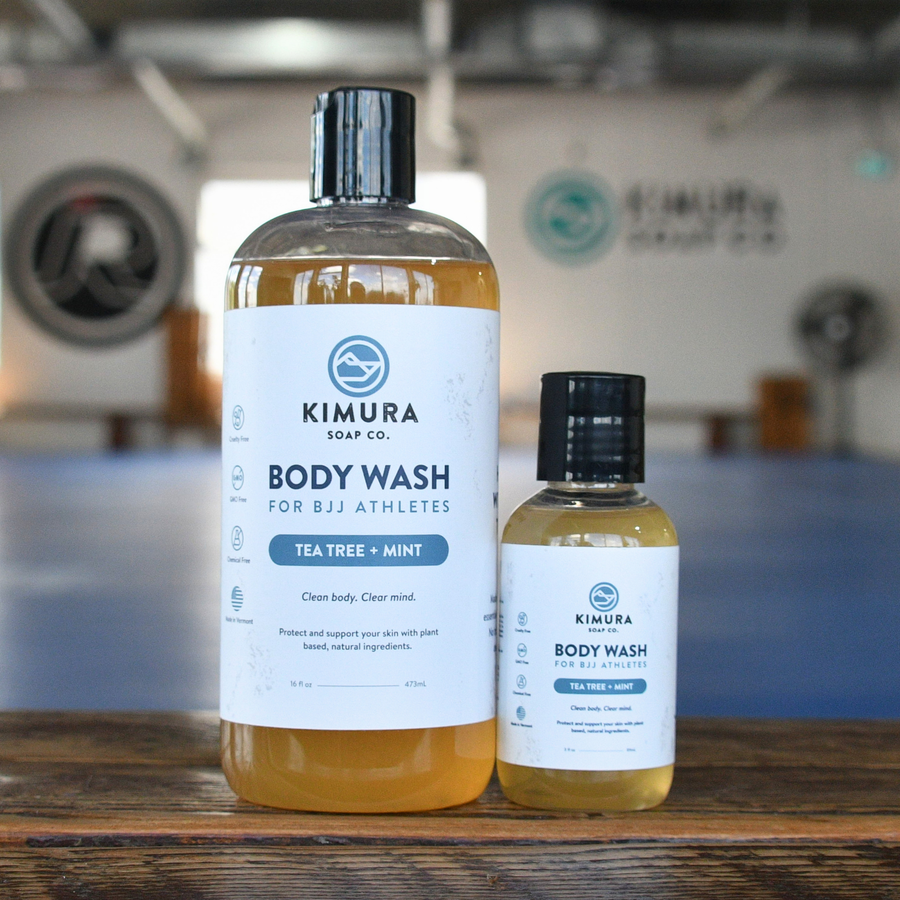
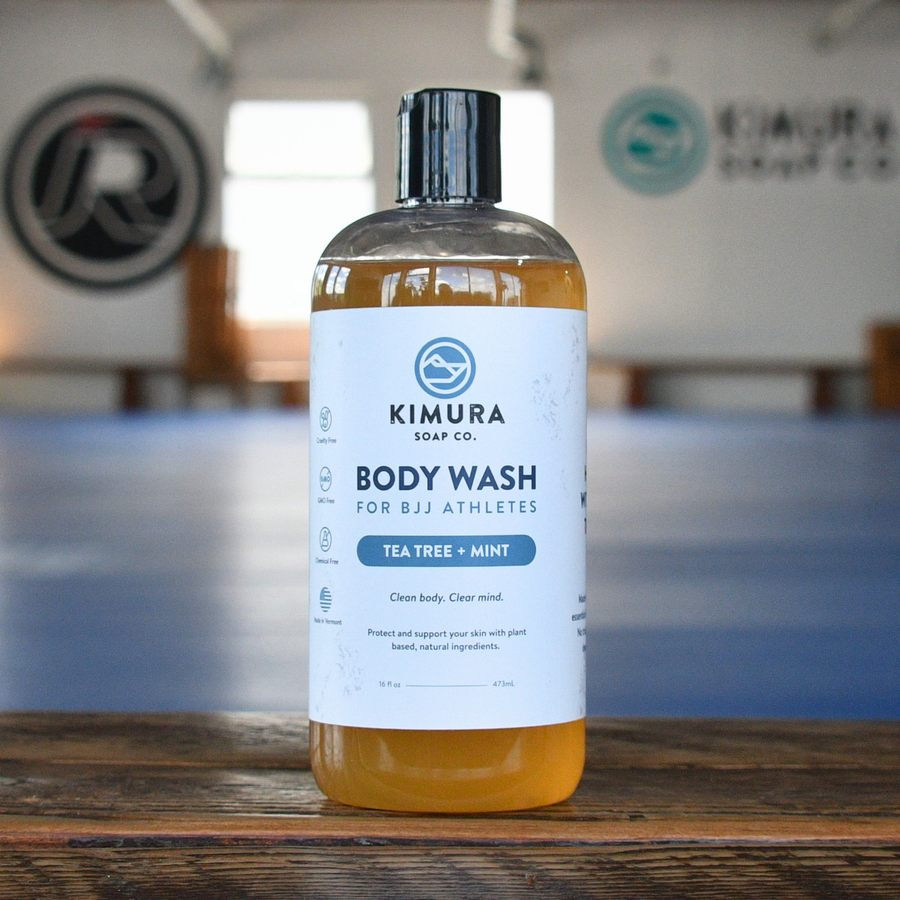
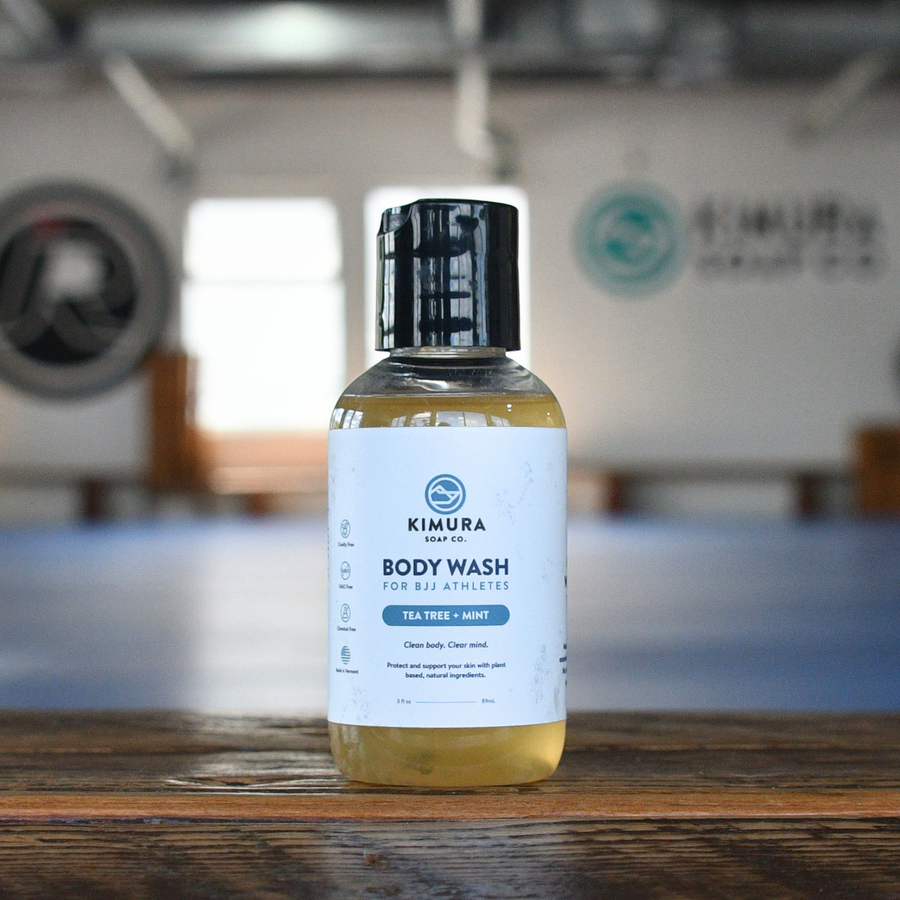
Kimura is a plant-based formula built around the ingredient rather than the scent, made in Vermont in small batches and certified to USDA Organic standards by Vermont Organic Farmers. It was created by a Brazilian jiu-jitsu black belt who trained for years before formulating a wash around what athletes actually need to remove after training. The base is organic saponified oils (coconut, olive, and jojoba) with vegetable glycerin, organic guar gum, organic aloe vera, and rosemary extract. The essential oil blend pairs tea tree with peppermint, cornmint, cedarwood, lavandin grosso, and orange. Tea tree is the functional anchor of that blend; the others contribute balance and sensory quality.
The essential oil blend, tea tree included, is formulated at the percentage recommended for body and foot care products. The exact ratios are proprietary. That matters in context: a daily wash should sit well below the high therapeutic concentrations used in clinical trials, which is appropriate for a product meant to clean skin after training rather than to treat a condition.
The formula contains no triclosan, parabens, phthalates, synthetic fragrances, or dyes. The contrast with synthetic antibacterial soap is the relevant one. Triclosan was the long-standing default in that category until the U.S. Food and Drug Administration restricted it in over-the-counter consumer wash products. Building around a documented plant compound reflects a different standard: choose an ingredient with a real evidence base, keep the rest of the formula clean, and publish the full ingredient list in plain language so the product can be judged by its contents.
Why peppermint and cornmint ride alongside the tea tree
Peppermint and cornmint are high in menthol, which produces a cooling sensation after a hard session. The practical reason this matters is adherence. A soap only helps if it gets used after every class, and a wash that feels like a reset is one an athlete reaches for consistently. Cedarwood, lavandin grosso, and orange round out the blend without shifting the formula toward fragrance for its own sake.

What tea tree oil soap can and can't do for mat hygiene
A soap is one layer of protection, not a substitute for the rest. No wash treats, cures, or prevents a skin infection, and any product claiming otherwise is overstating what a cleanser does. What a well-designed training soap delivers is straightforward: it cleans skin after training using an ingredient selected for documented properties rather than scent.
The rest of the system stays with the athlete. The complete hygiene stack includes showering promptly after class, washing the gi after every session, keeping open cuts off the mats, performing regular skin checks, and reporting anything suspicious early so partners can respond. A good soap makes the first of those steps more deliberate. It does not replace the others.
Why freshness and sensitivity matter
Tea tree oil oxidizes when exposed to air and light, and oxidized oil is more likely to irritate skin than fresh oil. A small percentage of people are sensitive to it regardless. Two implications follow. Store the product sealed and away from heat and light, and discontinue use if skin reacts, consulting a professional if needed. "Plant-based" does not mean "suitable for every person," and treating those as equivalent would be the kind of overstatement this article argues against.

What changes when tea tree oil anchors your post-training routine
The shift is concrete. The gym, the rounds, and the shared mats stay the same; the difference is that the one variable under the athlete's control is chosen on evidence rather than left to whatever was on sale.
The result is a post-training routine where the part you control is no longer the weak link. The soap is selected for a documented ingredient, the ingredient list is known, and the wash pairs with gi laundering and skin checks to form a hygiene system rather than a habit performed on autopilot. The outcome is not a guarantee against infection, which no soap can offer. It is a controllable layer handled correctly, consistently, and for a reason.
How to get the most out of a training soap
Technique matters as much as the product. Shower as soon after class as practical, since organisms have less time to establish on skin that is cleaned promptly. Use warm rather than scalding water, which cleans effectively without stripping the skin barrier that helps defend against infection. Cover the high-contact areas grappling loads most: the feet and between the toes, the neck and behind the ears, the forearms, and anywhere the gi creates friction. Lather, leave the soap in contact for a few seconds rather than rinsing instantly, and dry thoroughly afterward, because residual moisture is what fungal infections need to take hold.
The new standard for choosing a BJJ soap: read the label first
Use a single test for any soap marketed to grapplers. Disregard the front-of-bottle claims and read the ingredient list. Identify the functional ingredient, confirm whether documented science stands behind it, and check whether the brand is honest about the limits of what a soap can do.
So, why use tea tree oil for BJJ soap? Because it is one of the few wash ingredients with a real research record behind its antimicrobial and antifungal properties, and because a brand willing to anchor a formula on it and publish the full ingredient list is signaling how it treats the truth about everything else. The next time you restock, will you choose the soap that smells best, or the one you can defend ingredient by ingredient? Keep your own bottle in your gym bag and make the post-training wash the most deliberate part of your hygiene routine.
Share